
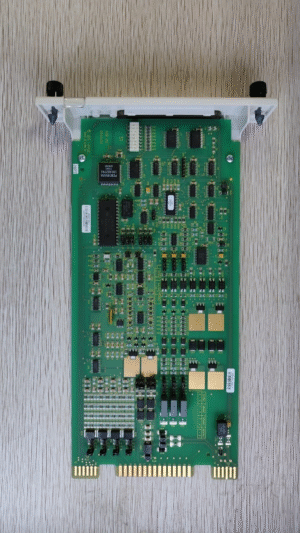

The ABB SPCIS22 module strengthens modern industrial control systems with advanced processing capability, stable architecture, and predictable performance behavior. The module supports ABB Bailey INFI-90 / Harmony systems, and it handles complex control logic while maintaining fast communication across distributed nodes. Because many industries demand uninterrupted operation, manufacturers prefer the SPCIS22 for its long-term durability and scalable design. Moreover, engineers choose it when they want smooth integration, predictable diagnostics, and continuous operation without unnecessary complexity.
To help users understand the SPCIS22 more clearly, the following sections explain its specifications, functions, electrical characteristics, environmental limits, mechanical structure, and integration workflow. Furthermore, the article uses clear transitions to ensure strong readability while keeping content SEO-oriented and technically authoritative.
1. Product Overview
The ABB SPCIS22 module works as a specialized control interface card inside automation cabinets. It communicates with system nodes, handles high-speed data transactions, and executes local logic instructions. Because many legacy and modern ABB systems rely on modular expansion, the SPCIS22 fits into standard racks without modification. Engineers install it when they need a stable platform that supports long-life operation and predictable behavior across high-demand industrial environments.
Furthermore, the module optimizes signal routing and data conditioning. It improves reliability in distributed control systems (DCS) where precise coordination matters. As processes grow larger and more interconnected, plants require modules that keep timing accuracy consistent. Therefore, the SPCIS22 ensures deterministic behavior across process loops while avoiding delays that could compromise system output.
2. Key Functional Capabilities
The SPCIS22 includes several core features that make it valuable in industrial automation. Each function contributes to overall performance, and users benefit from its balanced design:
2.1 High-Speed Signal Processing
The module processes logic instructions rapidly, and it maintains stable cycle times. Consistent execution helps operators tune loops more accurately. Since industries require predictable operation, this characteristic makes the SPCIS22 an ideal choice.
2.2 Enhanced Data Integrity
Strong data handling routines ensure message consistency between nodes. The module checks transmission correctness, and it filters out irregular or corrupted packets before they enter higher-level logic. Therefore, system engineers gain trustworthy information at all times.
2.3 Flexible System Integration
The SPCIS22 connects with cabinet backplanes used across ABB INFI-90 and Harmony systems. Its communication points align with system architecture, and it allows modular growth without redesign. As plant operations evolve, technicians add or replace modules smoothly.
2.4 Diagnostic and Event Tracking
Built-in status indicators allow operators to monitor real-time health conditions. The module creates clear diagnostic patterns, and it simplifies maintenance because it shows module readiness, communication state, and hardware status using a straightforward LED scheme.
3. Technical Specifications
3.1 Electrical Characteristics
The SPCIS22 follows strict electrical design rules to ensure long-term stability.
Rated Voltage: Typically aligns with standard ABB cabinet supply (5 VDC logic, 24 VDC auxiliary ranges).
Power Consumption: Low consumption ensures efficient thermal behavior and extended module life.
Isolation Mechanisms: Internal isolation protects logic areas from disturbances across the system.
Signal Noise Handling: Filtering circuits stabilize digital communication and prevent false triggering.
These characteristics increase system uptime and reduce interference risks.
4. Mechanical Construction
The ABB SPCIS22 module features a robust PCB structure fixed inside an industrial-grade housing. The module uses gold-plated connectors that maintain reliable conductivity over many years. Because industrial environments often expose electronics to vibration, humidity, and temperature changes, ABB designs the card to maintain mechanical integrity even under continuous operation.
The front plate includes:
Clear status LEDs
Module identification label
Troubleshooting reference icons
The rear edge includes:
Backplane connector
Grounding path
Structured pin routing
The simple physical layout shortens installation time and reduces the chance of wiring mistakes.
5. Environmental Operating Conditions
The SPCIS22 supports a wide range of environmental limits, allowing it to operate in many industries including power, petrochemical, metallurgy, and manufacturing.
Operating Temperature Range: Typically –20°C to +70°C
Storage Temperature: –40°C to +85°C
Permissible Humidity: Up to 95% non-condensing
Vibration Tolerance: Meets industrial shock-resistant specifications
EMC Compliance: Filtered circuits protect logic from electromagnetic interference
Because many industrial plants experience heat or electrical noise, these specifications ensure predictable behavior even during stressful conditions.
6. Communication Structure
The SPCIS22 supports fast communication methods used in ABB cabinet architectures. The module links process I/O modules, communication processors, and higher-level controllers. It exchanges data continuously and coordinates actions in real time. The optimized internal routing ensures that the module handles constant traffic without delays or bottlenecks.
Signal scheduling follows a prioritized method that keeps critical processes updated first. Therefore, industries with high-precision requirements—such as power generation or chemical refining—prefer the SPCIS22 due to its timing consistency.
7. Integration Into ABB Control Systems
The SPCIS22 integrates seamlessly into ABB Harmony / INFI-90 racks. Installation follows these simple principles:
Align the module with the designated rack slot.
Insert the card firmly to ensure backplane connection stability.
Confirm front-panel LED indicators show normal logic function.
Register the module within system configuration tools.
Validate communication and begin runtime process interaction.
Because many automation rooms use mixed generations of ABB modules, the SPCIS22 supports both modernization projects and legacy maintenance programs. Its compatibility ensures smooth upgrades without system redesign.
8. Reliability and Life-Cycle Performance
Industrial customers choose the SPCIS22 because it delivers long-term stability. The module uses reinforced components with extended life ratings, and the design avoids unpredictable thermal stress. Engineers appreciate how consistently the card runs in harsh conditions, and maintenance teams value its self-diagnostics, since they shorten troubleshooting cycles.
Furthermore, ABB supports long-term availability for this module, allowing plants to maintain uniform system architecture rather than mix incompatible hardware.
9. Typical Application Fields
The SPCIS22 operates across many industries, including:
Power generation and distribution
Oil and gas refining
Chemical processing
Metallurgy and materials engineering
Pharmaceutical manufacturing
Intelligent factory automation
Because these industries demand accuracy, safety, and uninterrupted flow, the SPCIS22 proves essential for critical loops and communication paths.
10. Conclusion
The ABB SPCIS22 module strengthens industrial automation by delivering fast logic execution, reliable communication, and stable physical construction. The design supports ABB Harmony / INFI-90 architectures and ensures long-term performance across many applications. As industries grow more complex, the SPCIS22 continues to provide trusted control reliability, efficient data handling, and integration simplicity.
If you need a modern, scalable, and robust solution for mission-critical process control, the SPCIS22 delivers the precision and durability required for advanced industrial environments.

Reviews
There are no reviews yet.