
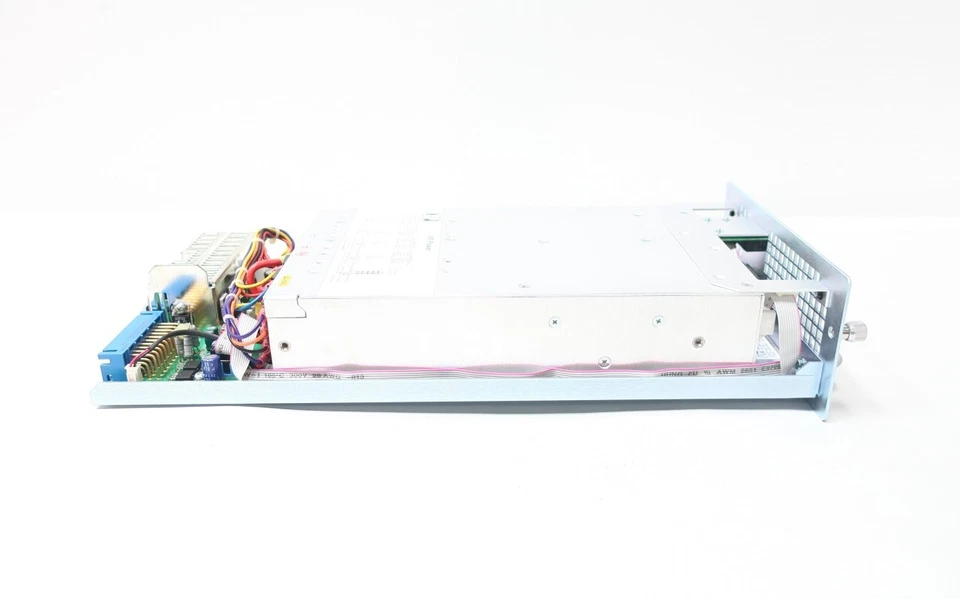
The ABB MPSIII Universal Type III Power System delivers a highly reliable and fully integrated power solution for large-scale industrial automation environments. It supports critical control platforms, long-cycle operational processes, and advanced distributed architectures. Moreover, it maintains continuous energy integrity across demanding scenarios, and therefore engineers select it as a strategic core for maintaining long-term equipment uptime. Because the system combines high electrical efficiency, real-time diagnostics, modular expandability, and robust environmental endurance, it strengthens power infrastructures across power generation, petrochemical, marine, and discrete manufacturing sectors.
1. Structural Design and Functional Philosophy
ABB structures the MPSIII around a centralized yet modular architecture. The framework organizes each functional block according to clear operational roles, and thus technicians configure capacity and monitoring layers with clarity and consistency. Furthermore, the platform arranges its power conversion modules and supervisory circuits so that every function communicates seamlessly across the cabinet.
The MPSIII uses advanced noise suppression and multi-stage filtering. Consequently, sensitive automation modules operate in an electrically stable environment, and signal consistency remains intact across long cable distances. In addition, maintenance teams interact with the system through intuitive indicator layouts and logically isolated processing paths, which improves troubleshooting speed and overall system transparency.
2. Electrical Performance and Power Delivery
The system delivers high-stability DC output that supports a wide range of ABB Bailey, Symphony, and other industrial control modules. It works within strict regulation tolerances, and therefore operators maintain uniform voltage distribution across all connected racks.
Key Electrical Specifications
Input Voltage Range: Broad industrial AC input tolerance, supporting global installation requirements.
Output Voltage: Typically 24 VDC regulated for control module operation.
Voltage Regulation: Tight dynamic stabilization with minimal ripple.
Efficiency: High-efficiency conversion that reduces cabinet heating and energy waste.
Load Handling: Supports both distributed and centralized load arrangements across multiple module families.
Protection Features: Over-current limiting, thermal shutoff logic, and surge protection.
Additionally, the MPSIII integrates redundant power switching, which ensures that transitions occur seamlessly during load redistribution. Because the design follows strict industrial safety standards, electrical disturbances fail to compromise downstream automation equipment.
3. Thermal Management and Environmental Endurance
ABB designs the system to endure continuous 24/7 operation across harsh industrial conditions. It includes an intelligent thermal layout that channels airflow precisely through high-density conversion paths. Furthermore, the cabinet structure aligns with high-grade environmental sealing, which improves long-term durability.
Environmental Characteristics
Operating Temperature: Wide thermal range suitable for indoor industrial cabinets.
Humidity Tolerance: Components withstand high-moisture environments common in chemical and power facilities.
Vibration Resistance: Mechanical stability ensures reliable operation near turbines, compressors, and heavy mechanical equipment.
As a result, the MPSIII remains structurally and electrically stable even when surrounding infrastructure encounters mechanical or climatic stress.
4. Monitoring, Diagnostics, and Control Logic
One of the system’s strengths includes its comprehensive real-time monitoring suite. Engineers access operational data via clearly organized LED indicators and supervisory signals. Furthermore, the system communicates fault states immediately, enabling early intervention.
Monitoring Features
Input/Output Status Indicators for rapid visual confirmation
Thermal Condition Alerts
Load Level Monitoring
Redundancy Path Tracking
Operators integrate the MPSIII into higher-level maintenance workflows, and therefore predictive maintenance becomes more accurate. The system communicates consistently with ABB automation networks, and it supports planned service cycles without operational disruption.
5. Mechanical Specifications and Cabinet Integration
The ABB MPSIII fits seamlessly into standard industrial control cabinets. Its mechanical structure follows ABB’s long-established modular rack philosophy. Moreover, its mounting design allows quick installation, straightforward cabling, and easy access during scheduled maintenance.
Mechanical Highlights
Compact Industrial Footprint suitable for control rooms and equipment cabinets
Rigid Metal Chassis with corrosion-resistant coating
Organized Front-Access Layout for rapid replacement
Optimized Cable Routing that improves airflow and visual clarity
Because each component aligns structurally with ABB’s ecosystem of automation modules, system integrators deploy the MPSIII efficiently during upgrades or expansions.
6. Compatibility and Application Scenarios
The MPSIII works across a broad spectrum of industries, and therefore specialists rely on it when stable and protected power becomes essential.
Common Applications
Power plant DCS power distribution
Chemical and petrochemical process control
Oil and gas pipeline supervisory systems
Marine automation panels
Water treatment SCADA platforms
Metallurgy and material handling systems
Additionally, integrators deploy the MPSIII when upgrading legacy ABB Bailey systems. Its architecture supports smooth transitions from older platforms, which preserves investment value while enhancing system reliability.
7. Advantages Across Industrial Projects
The ABB MPSIII establishes itself as a leading power platform because it combines reliability, flexibility, and high system intelligence. Moreover, it minimizes downtime risk, stabilizes automation networks, and simplifies long-term maintenance. As industries continue to prioritize energy efficiency and continuous operation, this system supports future growth with strong foundational design.
Reviews
There are no reviews yet.