
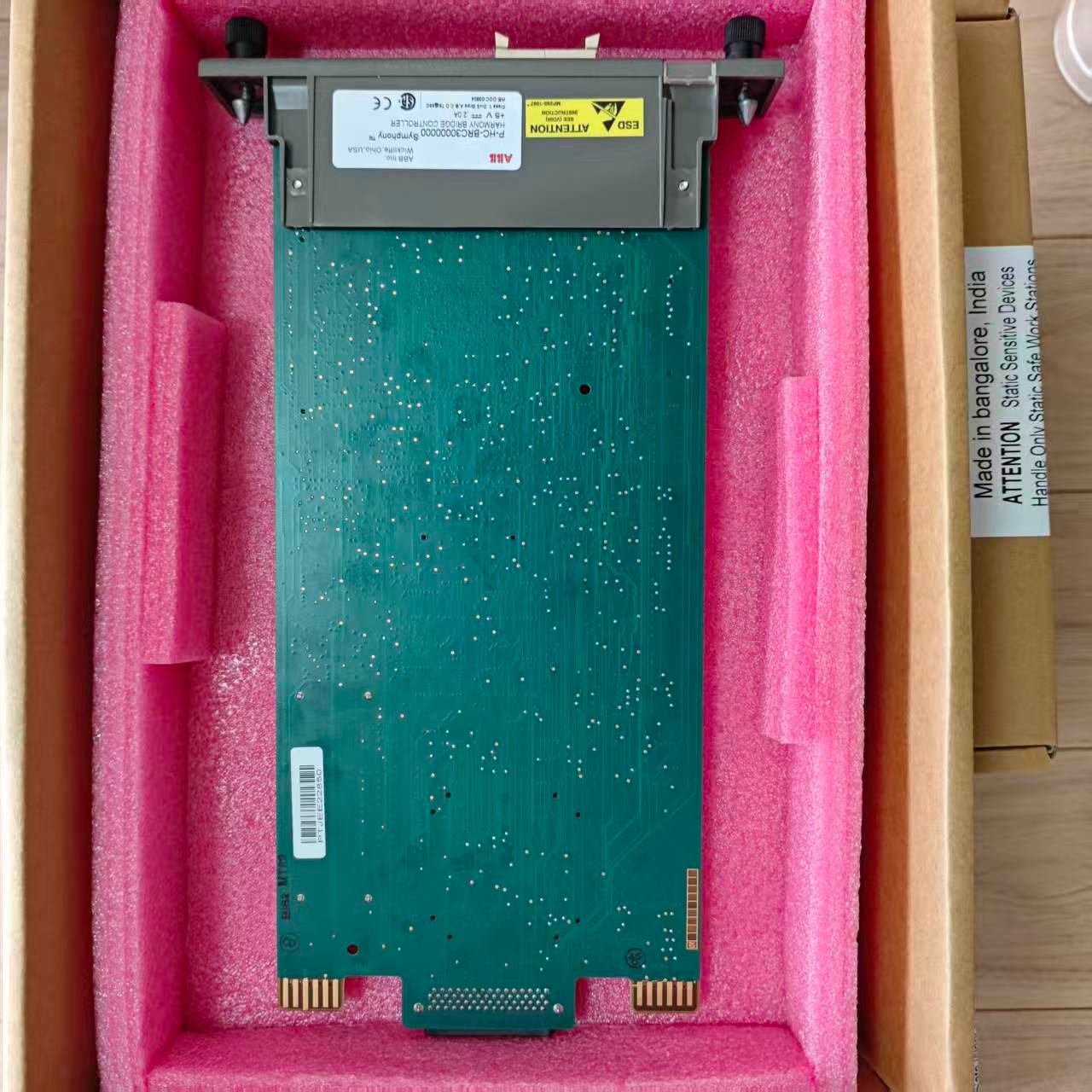

The ABB HARMONY SPBRC300 bridge controller ensures high-performance industrial automation because it provides precise control, reliable data communication, and consistent system stability. Modern industrial plants require robust management of multiple subsystems, and the SPBRC300 supports these demands through advanced bus management, deterministic signal processing, and seamless integration with ABB automation platforms. Engineers value this controller for its compact design, flexible connectivity, and ability to maintain predictable operation across diverse industrial networks.
The controller functions as a central communication hub, coordinating signals between ABB I/O modules, processors, and supervisory systems. Consequently, it improves system reliability and reduces latency, ensuring that critical control loops operate without interruption. The SPBRC300 also minimizes configuration complexity, enabling fast deployment and smooth expansion of automation networks.
1. Core Functional Role
The SPBRC300 serves as a high-speed bridge controller that manages data exchange and system coordination across multiple ABB devices. It guarantees deterministic communication, prioritizes critical signals, and maintains data integrity under high-load conditions. Additionally, the controller facilitates communication between legacy modules and modern digital systems, allowing plants to upgrade or expand infrastructure without disrupting existing operations.
By distributing control commands efficiently, the SPBRC300 ensures that each connected subsystem receives timely and accurate information. This capability strengthens plant-wide process control, supports advanced automation strategies, and enhances overall operational performance.
2. Key Features
2.1 High-Speed Bus Coordination
The controller optimizes bus communication across nodes, reduces latency, and prevents data collisions. It maintains stable and predictable data flow, which is essential for time-sensitive applications such as manufacturing lines, chemical processes, and energy management.
2.2 Reliable Signal Integrity
The SPBRC300 monitors all incoming and outgoing signals, identifies errors immediately, and preserves signal fidelity across the connected devices. These capabilities prevent communication failures and ensure accurate operation of feedback loops and control algorithms.
2.3 Advanced Diagnostics
The controller includes integrated diagnostic indicators and monitoring software, providing real-time visibility into operational status, bus activity, and system health. Maintenance teams can quickly identify anomalies, reducing downtime and improving overall system efficiency.
2.4 Seamless ABB Integration
The SPBRC300 complies with ABB cabinet layouts and mechanical standards, enabling fast installation and replacement. It integrates effortlessly into both existing and new systems, supporting gradual upgrades and modular expansion without operational disruption.
3. Technical Specifications
Operating Voltage: Compatible with ABB cabinet systems
Power Consumption: Low-energy design ensures thermal stability
Bus Protocol Support: ABB industrial communication standards
Communication Rate: High-speed, deterministic data exchange
Environmental Tolerance: Wide temperature and humidity ranges
Electromagnetic Compliance: Built-in shielding minimizes interference
Vibration Resistance: Reinforced design withstands industrial vibrations
These specifications make the SPBRC300 ideal for industrial plants where stability, precision, and reliability are critical.
4. Mechanical Design
The SPBRC300 features a durable enclosure optimized for ABB cabinet systems. It includes vibration-resistant backplane connectors, compact form factor, and front-panel LEDs that indicate operational health, communication activity, and error conditions. The modular design enables quick installation and replacement while maintaining airflow and thermal efficiency.
5. Environmental Durability
The SPBRC300 operates reliably under harsh industrial conditions, including temperature fluctuations, high humidity, and mechanical shock. Advanced thermal management and shock-resistant components allow continuous operation in demanding environments, making it suitable for chemical plants, manufacturing facilities, power stations, and water treatment plants.
6. Integration and Deployment Workflow
Installation and deployment of the SPBRC300 follow a straightforward workflow:
Insert the controller into the designated cabinet slot.
Align and secure the backplane connectors.
Connect the bus lines according to ABB standards.
Verify operational status via front-panel LEDs.
Configure the controller using ABB system software.
This structured workflow simplifies commissioning and ensures fast, reliable integration.
7. Reliability and Lifecycle Performance
ABB designed the SPBRC300 for long-term industrial use. Its high-quality components, robust thermal management, and advanced error-handling mechanisms ensure consistent performance over time. Maintenance teams benefit from predictable control behavior, reduced downtime, and minimal troubleshooting effort, enabling uninterrupted plant operation.
8. Application Scenarios
The SPBRC300 supports a wide range of industrial applications, including:
Manufacturing automation
Chemical and petrochemical processing
Water treatment and distribution
Power generation
Material handling systems
In all scenarios, the SPBRC300 provides precise signal management, robust communication, and reliable control to optimize plant performance.
Conclusion
The ABB HARMONY SPBRC300 bridge controller strengthens industrial automation by providing high-speed bus coordination, reliable signal integrity, and robust environmental resilience. Its seamless integration with ABB systems ensures continuous, efficient operation, making it the preferred choice for plants seeking precise, dependable, and scalable bridge control across complex industrial networks.
Reviews
There are no reviews yet.