
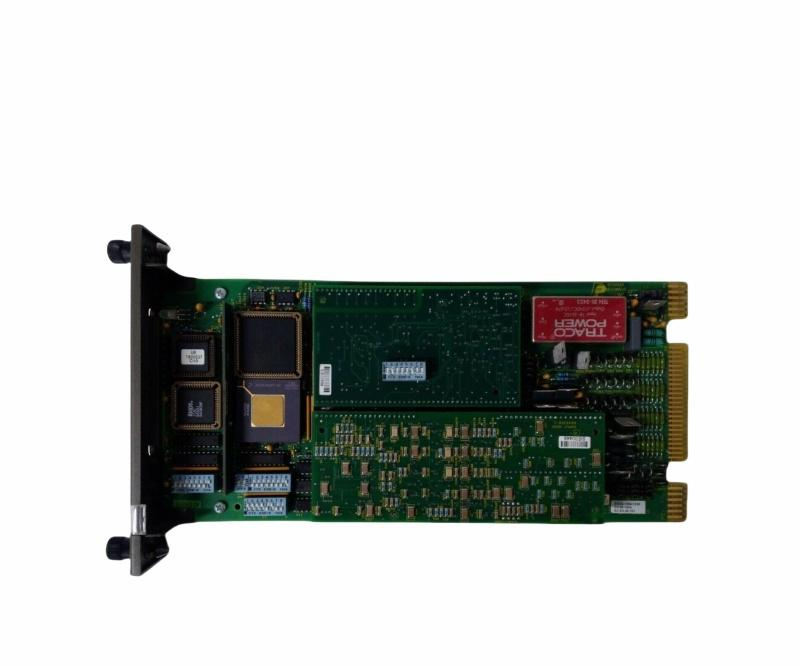

The ABB INFI-NET to INFI-NET Interface INIIT13 introduces a new generation of deterministic communication inside complex industrial control systems. Although countless distributed networks operate with different loads and priorities, the INIIT13 creates a unified and stable communication layer that supports fast data transmission across redundant or separated INFI-NET domains. Furthermore, the module strengthens system integrity because it links primary networks, backup networks, and extended segments with balanced throughput and consistent timing accuracy. Therefore, users who deploy large-scale systems such as power generation units, petrochemical platforms, metallurgy plants, or advanced manufacturing lines consistently choose the INIIT13 to maintain both reliability and long-term scalability.
As industrial automation expands toward higher speeds, more signals, and stronger cross-system collaboration, engineers increasingly require modules that move data without bottlenecks. Consequently, the INIIT13 integrates advanced digital processing, optimized INFI-NET protocol handling, and fault-tolerant circuitry so the entire communication backbone continues running efficiently even during peak loading. Moreover, ABB designs the module to operate inside Bailey INFI 90 systems, so it fits seamlessly within legacy plant architectures while also supporting modern high-speed components. Because of this compatibility, users upgrade networks gradually without creating downtime or risking configuration instability.
To help users evaluate the module clearly, the following sections describe its specifications, electrical ranges, environmental capabilities, timing characteristics, communication behavior, diagnostics, firmware architecture, installation guidelines, and system application advantages. Every section includes clear transitions so the content flows smoothly and supports AISEO-optimized structure.
1. Core Technical Specifications of ABB INIIT13
The ABB INIIT13 operates as an intelligent interface between two INFI-NET highway segments. Since each segment may include numerous nodes, controllers, and I/O elements, the module manages traffic balancing and queue handling so each data packet travels through the correct timing window. Additionally, it supports ABB’s deterministic network frame format, which ensures predictable response behavior.
Key Electrical and Data Specifications
Power Requirement:
The INIIT13 draws regulated power from the system backplane. Although the typical consumption stays low, the module includes internal stabilization circuits so voltage fluctuations on the rack do not affect signal precision.Processor Architecture:
The module uses a high-reliability microprocessor that handles message routing, buffer management, timing synchronization, and communication arbitration. Furthermore, the processor executes internal checks continuously to maintain link performance.Data Rate:
The interface supports the standard INFI-NET network speed. While the physical layer stays consistent with ABB’s requirements, the module optimizes frame transmission so network delays remain minimal even during heavy messaging.Memory Resources:
Internal RAM stores routing tables, retry queues, status flags, and system diagnostics. Additionally, non-volatile memory retains firmware logic and boot routines, allowing consistent recovery after system power cycles.Signal Isolation:
Optical and galvanic isolation protect the board from electrical interference across network segments. Consequently, cross-segment disturbances never propagate into the opposite side of the network.
2. Communication Protocol Characteristics
Because INFI-NET relies on synchronized frame sequencing, the INIIT13 continuously evaluates each communication cycle. Therefore, the module handles tasks such as error checking, collision prevention, message buffering, and segment priority control.
Major Protocol Functions
Frame Routing:
The module identifies the correct destination and moves frames between network segments without losing order.Error Checking:
Real-time CRC verification ensures clean data transmission. Furthermore, corrupted frames trigger immediate re-requests and status flags.Status Reporting:
The module updates the system network manager with link health, retry counters, and queue lengths so operators monitor performance effectively.Clock Coordination:
Although the module does not replace a time-synchronization master, it cooperates closely with timing devices so frame alignment stays precise across the entire network.
3. Environmental and Durability Ratings
Industrial networks often operate under challenging conditions. Consequently, ABB engineers design the INIIT13 to tolerate electrical noise, temperature variations, humidity, and long operating cycles.
Environmental Tolerance
Operating Temperature Range:
Standard industrial range suitable for control room or cabinet installation.Humidity:
The board includes protective coatings and controlled-flow design so moisture does not affect circuitry.EMI Immunity:
Built-in shielding minimizes interference from high-power drives, switchgear, and heavy motors.
4. Installation and System Integration
Although complex automation systems require meticulous configuration, ABB ensures that INIIT13 installation follows a predictable path. Engineers insert the module into the appropriate slot, secure connectors, and complete network wiring. Afterward, configuration software assigns routing behavior and network roles.
Installation Advantages
The module fits existing INFI 90 racks.
It integrates with system configuration tools seamlessly.
Front-panel indicators provide immediate status confirmation.
Diagnostic codes guide engineers through troubleshooting efficiently.
5. Operating Behavior and Network Redundancy
Large industrial networks must continue running even when single modules fail. Therefore, the INIIT13 supports redundancy structures that allow secondary paths to take over instantly when primary connections degrade. The interface monitors link quality, detects retries, and shifts communication through the alternate segment smoothly when necessary.
Redundancy Strengths
Continuous health monitoring
Fast switching during network instability
Balanced traffic distribution across both paths
Improved availability for mission-critical systems
6. Application Scenarios
The ABB INIIT13 operates in several industries because stable networking forms the backbone of modern automation. Furthermore, many legacy plants still rely on ABB INFI 90 systems, so the INIIT13 provides a smooth upgrade route.
Common Use Cases
Power Generation:
Boiler control, turbine automation, and plant-wide data synchronization.Petrochemical Automation:
Pipeline monitoring, reactor control, and distributed safety integration.Metallurgy and Materials Processing:
Furnace control, rolling units, and centralized quality tracking.Manufacturing and Advanced Production Lines:
Coordinated motion systems, batch management, and supervisory data exchange.
7. Diagnostics and Maintenance Features
The module constantly reviews internal resources. Moreover, engineers access diagnostic registers to evaluate queue depth, error rates, and frame timing conditions. Because the interface displays activity codes on the front panel, operators quickly identify communication status without disassembling hardware.
Diagnostic Benefits
Real-time error visibility
Clear fault indicators
Troubleshooting support through system tools
Long-term reliability tracking
8. Conclusion
The ABB INFI-NET to INFI-NET Interface INIIT13 delivers a complete networking solution for distributed control systems that require endurance, deterministic communication, and strong redundancy support. Since industries continue expanding their automation footprint, the INIIT13 ensures stable communication between independent INFI-NET domains while maintaining predictable system performance. Moreover, engineers who require long-term reliability consistently integrate this module because it strengthens the communication backbone, simplifies maintenance, and supports flexible expansion without compromising uptime.

Reviews
There are no reviews yet.