
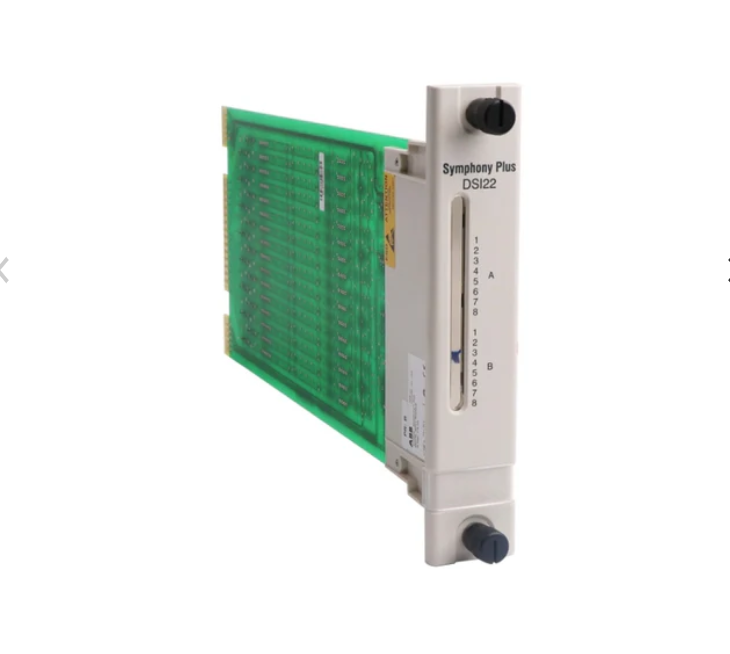

The ABB Bailey SPDIS22 Digital Input Module plays a central role in modernized industrial control architectures that rely on accurate digital signal processing. I describe the SPDIS22 as a performance-driven, reliable, and intelligently engineered digital input module designed for INFI 90 and NET 90 systems. Furthermore, I highlight its strong ability to capture real-time digital states while supporting long-term stable operation in demanding environments such as power generation, petrochemicals, heavy manufacturing, and utility automation.
From the moment engineers integrate the SPDIS22 into a control rack, the module delivers clean, precise, and timely digital data acquisition. Moreover, it supports flexible configuration options that help system designers shape digital input behavior according to process requirements. Since high-speed digital state detection forms the foundation of safe, automated decision-making, the SPDIS22 strengthens the control system with dependable accuracy, noise immunity, and superior long-term performance.
1. Product Overview
The ABB SPDIS22 functions as a high-reliability digital input module that collects discrete on/off field signals and communicates these states to the main controller. Because modern industrial processes rely on digital triggers—such as limit switches, relays, pressure switches, flow interlocks, and machine safety elements—the module ensures every state change reaches the control processor immediately and accurately.
Although many digital input cards exist across automation systems, the SPDIS22 stands out due to its fault-tolerant architecture, strong environmental endurance, and seamless compatibility with legacy and upgraded Bailey DCS platforms. Engineers often select it for long-running, mission-critical installations that require predictable, noise-immune operation.
2. Key Features of the ABB SPDIS22
I summarize the core benefits of the SPDIS22 as follows:
✔ High-Accuracy Digital Input Detection
The module captures discrete signals with excellent precision, even in electrically noisy industrial facilities.
✔ INFI 90 and NET 90 Compatibility
It interfaces smoothly with classic Bailey infrastructures without requiring hardware redesign.
✔ Strong Electrical Isolation
Each channel maintains isolation that prevents ground loops, surges, and control-side interference.
✔ Real-Time State Reporting
Fast update cycles help operators react immediately to changes in field equipment.
✔ Industrial-Strength Durability
The rugged construction enables stable performance across wide temperature swings, vibration, and harsh plant conditions.
✔ Easy Maintenance and Module Swapping
Engineers enjoy straightforward installation, troubleshooting, and replacement procedures.
Because these features align with long-term control system demands, the SPDIS22 supports a stable, scalable, and maintainable automation architecture.
3. Detailed Technical Specifications
To support engineering evaluation, I organize the SPDIS22’s technical characteristics as follows:
3.1 Electrical Characteristics
Module Type: Digital input processing unit
Input Signal Type: Standard ON/OFF field signals
Typical Input Voltage Levels: Compatibility with industrial DC signal ranges
Update Speed: Fast digital scanning for real-time control
Isolation: Channel-to-ground and channel-to-bus isolation
Noise Rejection: Strong suppression through built-in filtering
Internal Diagnostics: Continuous self-monitoring for line and channel health
Current Draw: Optimized low-power consumption from backplane
Signal Conditioning: Debounce filtering for clean state recognition
These electrical parameters help engineers integrate the SPDIS22 into systems where digital reliability defines process safety and control accuracy.
3.2 Mechanical Specifications
Form Factor: Standard Bailey INFI 90 module card
Dimensions: Fits standard I/O module rack
Construction: High-strength industrial PCB and protective casing
Connectors: Reliable multipin connectors for secure data transmission
Mounting: Slides into standard Bailey rack positions
The module’s mechanical consistency supports long-term reliability, even when the control rack runs continuously for years.
3.3 Environmental Conditions
Operating Temperature: Typical industrial range from −20°C to +60°C
Storage Temperature: −40°C to +85°C
Humidity Range: 5%–95% non-condensing
Vibration Resistance: Acceptable for heavy industrial installations
Shock Tolerance: Designed for robust field conditions
Because industrial plants experience electrical and environmental stress, the SPDIS22’s resilience ensures uninterrupted functionality.
3.4 System Interface & Communication
System Compatibility:
ABB Bailey INFI 90
ABB Bailey NET 90
Harmony systems with compatible configuration
Backplane Communication:
The module communicates via Bailey’s standard I/O subsystem bus, enabling continuous digital data flow to the higher-level controllers.Status Diagnostics:
LED indicators help technicians confirm operational health, channel activity, and communication status.
4. Application Areas
The ABB SPDIS22 supports a broad spectrum of industries that rely on accurate discrete signal detection. I list the most common application fields:
✔ Power Generation
Thermal, hydro, and nuclear facilities depend on clean digital signal monitoring to safeguard critical sequences.
✔ Chemical & Petrochemical Plants
The module manages safety interlocks, pump states, and valve conditions.
✔ Water & Wastewater Processing
Operators track pump starts, level switches, and protection routines.
✔ Oil & Gas Automation
Digital signals from compressors, separators, and pipeline systems flow directly into the controller.
✔ Manufacturing & Industrial Machinery
Production lines rely on real-time limit switches and safety circuits.
✔ Metals & Mining
Harsh, high-vibration environments benefit from SPDIS22 durability.
Because every automation system requires reliable digital input processing, the SPDIS22 serves as a foundation for stable plant operation.
5. Performance Advantages
I highlight several strengths of the SPDIS22 that give it an edge over general digital input cards:
1. High Signal Integrity
The module reduces false readings through excellent electrical noise immunity.
2. Fast Reaction to State Changes
Real-time updates help prevent delays in sequence logic.
3. Robust Backplane Communication
Stable bus transmission creates predictable controller behavior.
4. Long Service Life
Engineers trust the module for continuous multi-year operation without performance drift.
5. Streamlined System Integration
No redesign is required when upgrading or replacing modules within Bailey architectures.
These advantages contribute strongly to plant uptime and operational efficiency.
6. Why Engineers Choose the ABB SPDIS22
When industrial customers evaluate digital input modules, they prioritize stability, long-term reliability, and compatibility. The SPDIS22 satisfies all these needs by offering:
Strong digital accuracy in harsh conditions
Seamless integration into existing control systems
Long lasting component design
Efficient maintenance with straightforward diagnostics
Consistent response under demanding workloads
Because many industrial facilities continue using ABB Bailey architecture for its proven reliability, the SPDIS22 supports modernization without forcing expensive hardware upgrades.
Conclusion
The ABB Bailey SPDIS22 Digital Input Module stands as a dependable and high-performance component for industrial automation systems that require precise, stable, and real-time digital signal capture. Moreover, its rugged, intelligently engineered design ensures strong operation across challenging industrial environments. By supporting seamless system integration, excellent electrical integrity, fast scanning behavior, and long operational life, the SPDIS22 empowers engineers to maintain safe, efficient, and reliable plant processes across a wide variety of industries.


Reviews
There are no reviews yet.